


A clear offer passes two tests. The comprehension test checks that a prospect grasps what you sell, to whom and against what problem. The substitution test checks that a competitor could not put its name to your promise. Passing the first test does not guarantee passing the second: a rewritten offer can become easy to read without giving the prospect a reason to prefer it to a competitor’s.
The buyer’s preference forms before the first contact. According to the 2024 report by 6sense on the B2B buying experience, 81% of buyers already have a preferred vendor at the time of first contact, and 85% have largely settled their requirements before they reach out to a seller. A promise that a competitor could put its name to gives the buyer no reason to prefer you before that first conversation.
Source: 6sense, “6sense Launches 2024 Buyer Experience Report”, press release, 9 October 2024.
The comprehension test
The test asks one question: after a single reading, can the prospect say what you sell, to whom and against what problem? Clarity is measured by what the reader can restate.
This test is passed through writing: short sentences, the client’s vocabulary, the problem named before the solution. Passing it does not guarantee that the offer will be chosen.
The substitution test
Replace your company’s name with a competitor’s in your promise, your opening line and your closing line. If the sentences remain true, they do not set you apart.
General promises fail this test, because they list benefits that your competitors also claim. The Clear Offer Framework calls this flaw the “catch-all promise”: a promise too broad to organise the offer.
A case: a B2B software company and its dozen products
Here is a real case, anonymised. A B2B software company presents about a dozen products, each under its own name. Its offer fails both tests. Its presentation texts describe the products with adjectives and say neither what they are nor whom they are for. Its catalogue structure leaves prospects to work out which product answers their problem. Any competitor in its market could put its name to its general promise.
The two failures are fixed in different ways. The first calls for a rewrite that says what is sold and to whom. The second calls for a decision: name a central mechanism, that is, the way the products achieve their result, then present each product as proof of that mechanism.
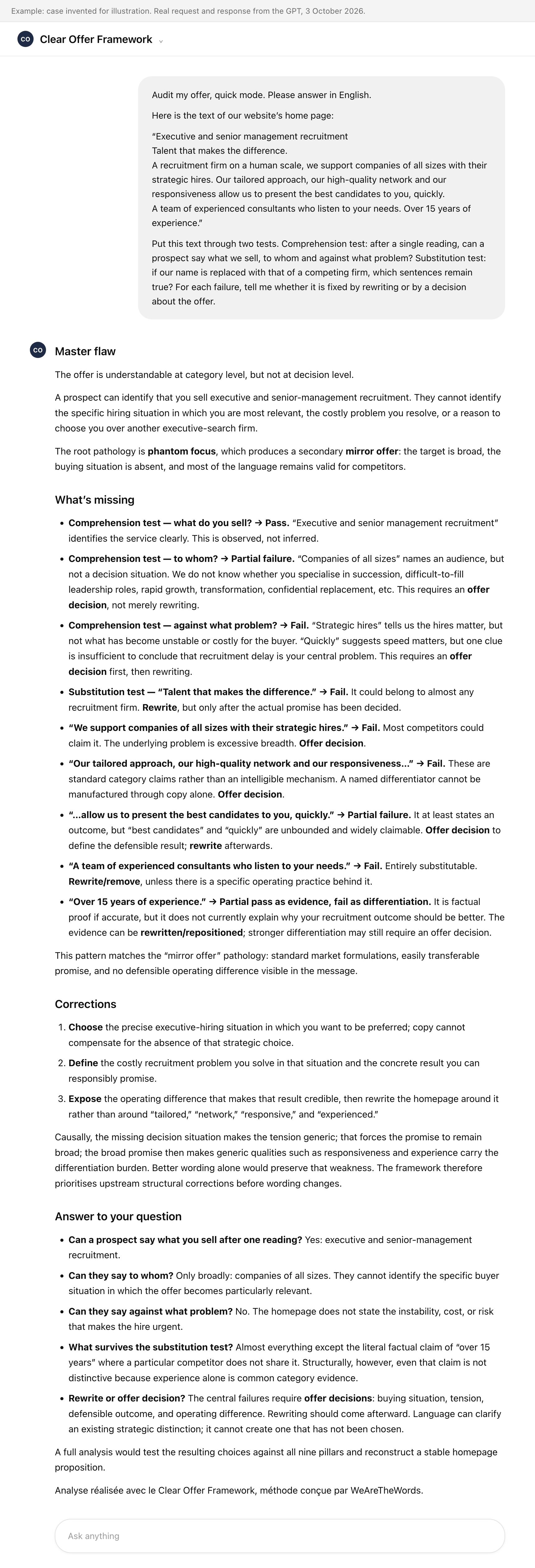
Here is a second case, invented for this article: the home page of an executive and senior-management recruitment firm. We submitted it to our Clear Offer Framework GPT on 3 October 2026. The page only partly passes the comprehension test: the prospect understands what is sold, but not against what problem. It fails the substitution test: almost every sentence would remain true under a competitor’s name. The GPT concludes that both failures call for a decision about the offer before any rewriting: the firm has chosen neither the problem it solves nor what sets it apart.
Why better writing is not enough
Better writing gets the offer through the comprehension test. It leaves the result of the substitution test unchanged, because that test is about choices: the target client, the problem addressed, the mechanism and the proof. As long as these choices remain open, better writing produces a promise that a competitor could put its name to.
These choices are made before the writing starts. They also come before any work on tone.
Putting your offer through both tests
- Have someone from outside your company read your offer page once. Then ask them to say what you sell, to whom and against what problem.
- Replace your name with a competitor’s in the promise, the opening line and the closing line of the page.
- If the offer fails the first test, rewrite the page. If it fails the second, go back to the choices behind the offer: the target client, the problem addressed, the mechanism and the proof.
Frequently asked questions about offer clarity
How do you know whether your offer is clear?
A clear offer passes two tests. After one reading, someone from outside the company must be able to say what the company sells, to whom and against what problem. The promise must then become false when a competitor’s name replaces the company’s.
What is the substitution test?
The substitution test consists of replacing the company’s name with a competitor’s in its promise. If the sentence remains true, the promise does not set the company apart. The test concerns the choices behind the offer: better writing is not enough to pass it.
Why is a well-understood offer not chosen?
An offer can be understood and still be interchangeable. B2B buyers often reach the first contact with a preferred vendor: 81% of them, according to 6sense in 2024. An offer that nothing sets apart gives them no reason to change their preferred vendor.
To settle the choices behind your offer, see the Clear Offer Framework.