
Clear Offer Framework

The method for structuring and governing your offer

The Clear Offer Framework turns an implicit offer into an architecture anyone in your organisation can carry, so your promise stays legible, credible and defensible once it no longer depends on one person to be explained properly.

The method for structuring and governing your offer
The core problem​
Your offer is clear in your head. It changes every time someone else explains it.
An ungoverned offer is an asset that loses value​

An ungoverned offer is an asset that loses value

Your offer has to be carried by several people, presented across several formats, phrased for several audiences. And it still depends on you to come out right. So every new context reopens the debate.

The promise. The mechanism. Which benefits to lead with. Corrections pile up, proposals contradict one another, and brand credibility erodes as the offer scatters.

In a growing organisation this shows up fast: the collateral multiplies, but the offer never settles. Each new salesperson starts from their own reading of it. Each new landing page reopens the question of the promise.

Every positioning decision, whether to enter a market, how to defend a price, what to lead with, gets made without a common base. Commercial legibility degrades. Preference never builds. An ungoverned offer is an asset that loses a little value every time someone speaks for it.

The method to success

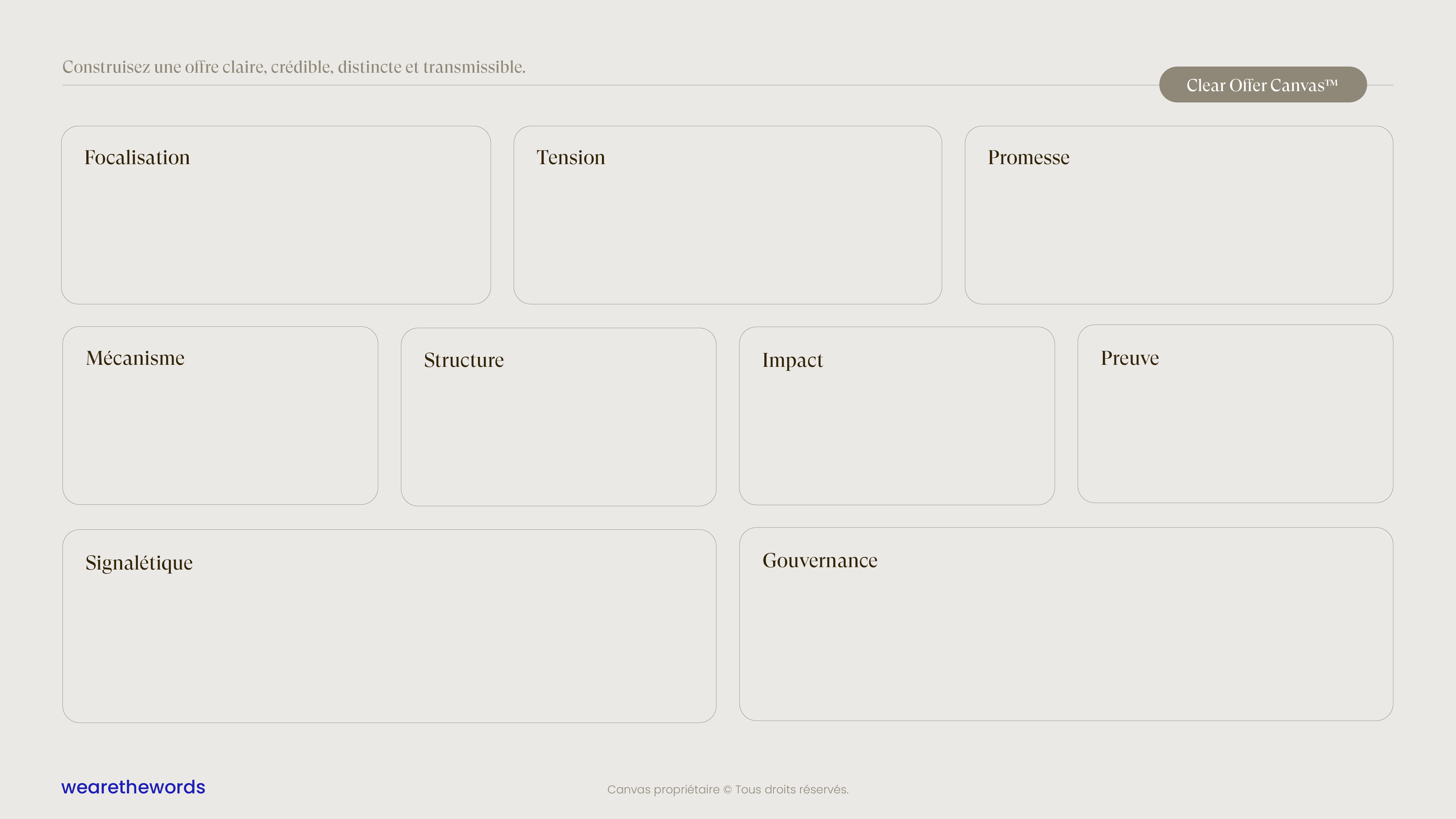
Nine locks. One offer architecture your teams can carry.

Most positioning exercises describe an offer. They do not lock it. The Clear Offer Framework works differently: each dimension produces a deliverable, and closes a door on interpretation.
One offer architecture your teams can carry
Lock the decision moment
We identify the exact moment your offer becomes relevant. Not a segment. A trade-off someone has to make. Without it, the promise stays generic and the tension is decorative.
Make inaction expensive
We formalise what the client loses if nothing changes. Not an aspiration: a situation that has become unstable. This is what makes the offer necessary rather than merely desirable.
Choose one central transformation
We set aside secondary benefits to stabilise what the offer actually changes. A promise that covers everything defends nothing. One well-set central transformation defends a great deal.
Explain how the result is produced
We rebuild the causal chain that produces the result, step by step, with the name of the method stripped out. A strong label never buys back a missing logic. Take the name away: if the offer collapses, there was no mechanism.
Organise understanding before deliverables
We reorganise the offer around how it is understood, not around a list of services. A catalogue offer gives too much room to what is delivered and too little to what makes the transformation credible.
Make the effects observable
We translate the promise into visible signs. “More clarity” will not do. What will do is being able to say exactly where it shows: in decisions, in sales cycles, in how the team is organised, in results.
Tie proof to the mechanism
We qualify the proof you already hold. Strong proof does more than reassure: it removes one specific doubt about the promise, the mechanism, or whether the result can be repeated.
Audit the depth of the language
We spot compensating language, the words that try to produce a perception the architecture does not yet support. “Bespoke”, “premium”, “high-value”: each one is a symptom.
Fix what does not move
We set the non-negotiable terms, the drifts that are off-limits, and the variants allowed by context. This is where the Clear Offer Framework becomes a system rather than one more document in a Drive.
The Clear Offer Canvas
The turning point

What you observe once it is deployed.

What you observe once it is deployed
Fewer re-briefs
Your teams have a frame. They stop reinterpreting the promise on every project, and correction loops shrink.
Sales proposals that agree with each other
The same offer core runs through every format: deck, landing page, pitch, email. Without you having to read all of it to be sure.
Differentiation you can defend

Your differentiation rests on the constraint that makes your mechanism hard to copy. Your teams can name it in the room, against a comparison table, or when the price comes under pressure.

A pitch anyone can carry from day one
A new salesperson, a new partner, a new agency: they have the reference. They present the offer in the right register without going through you.
An offer that supports growth
New service, new market, new channel: the Clear Offer Framework absorbs them without losing its central coherence. It gets more robust the more it is used.
A base for all your content
Articles, webinars, email sequences, AI tools: everything starts from the same structural core. The offer stops being reformulated for each format. It gets adapted.
The roles distribution

The same problem. Felt in a different place.

An offer that stops holding as soon as it spreads is a problem you meet whatever your role. What changes is where you feel it.
The same problem. Felt in a different place.
Executive
You carry the offer better than anyone, because you built it. But the moment you leave the room, something is lost. The Clear Offer Framework takes what you carry alone and puts it into a system your teams can operate without you.
Marketing
In a growing organisation, offer coherence is a matter of commercial credibility, not only of communication. You spend your time correcting materials that do not start from the same place. The Framework sets that place once.
Sales
You present the offer to demanding audiences. When the promise shifts from one salesperson or one document to the next, credibility takes a hit before the conversation even starts. A properly formalised mechanism changes that, and gives your argument more weight.
Consulting
You structure offers for your clients. With no documented method, you are the only guarantor of coherence, and what you deliver rests on you rather than on an asset that can be handed over. The Clear Offer Framework lets your providers take ownership of the material and defend it better.
The magic formula

One system. Three ways to deploy.

The Clear Offer Framework is the same whichever mode you choose. What changes is the level of support, and how deep it goes into your organisation.

Autonomy

With ChatGPT

Use the Clear Offer Framework directly in ChatGPT. The agent walks you through it step by step, at your own pace, to build the foundations of your offer architecture.

What you get:

  • A guided path through the nine dimensions
  • A first diagnostic that surfaces your critical fault line and your openings
  • A base for briefing your teams, rewriting your materials, framing your AI tools

What the GPT does not do: bring the situated judgement a complex governance problem requires.

Estimated time: 45 minutes to 2 hours, depending on how deeply you answer. ChatGPT account required. Free access.

Best choice

Mission

With our experts​

Your offer carries critical business stakes. It has to hold across an organisation, several audiences and multiple channels, and survive the pressure of day-to-day selling.

What you get:

  • A structured, documented diagnostic of how mature your current offer is
  • Your Clear Offer Framework, built with our experts
  • Deliverables you can act on: offer architecture, lexicon, canonical wording, discourse governance guide
  • A governance frame that holds once you are no longer in the room

We do not rewrite your offer. We constrain it structurally. And we stay to make sure it holds.

Training

With your teams

You want to deploy the Clear Offer Framework in-house, with your own teams, inside a structured method facilitated by WeAreTheWords. Not to outsource it. To bring people in.

What you get:

  • The full method, taught and facilitated by our experts
  • A collaborative working frame that aligns every stakeholder
  • A deliverable built during the session: your documented Clear Offer Framework
  • The autonomy to keep it alive, enrich it and deploy it afterwards, with no dependency

Format: two days, on site or remote.

Open workshops or in-house sessions.

FAQ
No. It structures your thinking and produces a first diagnostic you can act on. For deployment across an organisation, with several audiences, several markets or a complex offer architecture, an engagement produces a significantly more robust and more durable result.
Yes. The GPT runs inside your own ChatGPT session. WeAreTheWords has access to none of it.
That is exactly where it earns its keep. It creates the shared reference every external contributor can consult and apply, with no reinterpretation and no re-brief every time.
The GPT structures your own thinking, on your own, at your own pace. The workshop aligns a team and hands over the method. The first produces a diagnostic you then have to carry; the second produces a shared frame your teams can operate without you. If your difficulty is clarifying the offer, start with the GPT. If it is making that clarity hold across several people, you need the workshop.

Between 45 minutes and 2 hours, depending on how deeply you answer. The result is usable straight away.

Between 6 and 12 weeks, depending on the size of the team and the scope under review.

A scoping call with our team. Free, no commitment. It lets us understand your actual situation and point you to the right mode of deployment, without selling you something you do not need.

That is the natural path. The Clear Offer Framework is the entry point to our Clarity offer, and gives you a solid base for starting an engagement with the architecture already in place. Beyond that, you can continue with Growth to steer your strategy over time, or Elite to orchestrate your brand governance.

In good hands​
Multidisciplinary​

Strategy. Architecture. Editorial. Three disciplines most agencies handle separately. We make them work together — because a fullstack offer stops being a discourse and becomes a system.

Autonomy​
We design tools that are accessible and fully appropriable, available open source — because offer structuring should be a built-in reflex, not an exceptional project.
Robustness​

We place robustness at the core of our recommendation and modelling frameworks — because a solid offer must be able to withstand shifts in time and variations in context.

Your offer deserves better than a pitch that changes with whoever delivers it. Model it. Constrain it. Make it governable.

Our other frameworks

Brand Voice Framework

WeAreTheWords, agence éditoriale fullstack
The Brand Voice Framework turns an implicit brand voice into an editorial system your teams can carry. One voice, across every contributor and every tool.